By Odita Sunday
For Major General Abdulsalam Abubakar, the command tour across the Theatre of Operation Hadin Kai was more than a routine military inspection. It offered an opportunity to look beyond maps, operational reports and statistics and directly assess the men, communities and facilities at the centre of Nigeria’s long-running battle against terrorism in the North-East.
As he rounded off the tour, the Theatre Commander left behind an operational picture defined by sustained pressure on terrorists, improved military presence, strengthened troops’ confidence and a growing emphasis on restoring normalcy in communities once dominated by insurgent violence. His engagements across key formations and forward operating locations also brought him face-to-face with the realities of a war that has entered a more complex phase.
From the Forward Operating Bases around Tungushe and Molai to Bulama Yunus and other critical locations, the tour exposed the scale of responsibility being shouldered by troops of Operation Hadin Kai. These are areas where soldiers operate in difficult terrain, often far from major population centres, confronting terrorist groups that have repeatedly demonstrated their capacity to adapt, regroup and launch attacks.
Yet, the story emerging from the theatre is no longer simply one of terrorists attacking communities and military formations. It is increasingly a story of a force taking the fight to the adversary, disrupting terrorist networks, denying them freedom of movement and gradually shrinking the space in which they can operate.
That changing reality has been reflected in the growing number of terrorists and their associates surrendering to the Nigerian military. The development represents one of the clearest indications that sustained military pressure, combined with the disruption of terrorist logistics and leadership structures, is having an impact on the insurgency.
Over the years, more than 16,000 terrorists and their families have surrendered within the theatre, presenting the military with another layer of responsibility beyond conventional combat operations. Every surrender brings with it questions of screening, investigation, rehabilitation, reintegration and, where necessary, prosecution.
The growing number of persons in military custody has also placed pressure on facilities and personnel responsible for managing detainees and suspects. During the command tour, attention was drawn to the military’s efforts to ensure that those in custody are not simply confined but are also engaged in productive activities. At one of the locations visited, detainees were observed learning skills, including the production of clothing, an approach that speaks to the broader objective of preparing eligible persons for eventual reintegration into society.
For those who refuse to lay down their arms, the military continues to apply kinetic pressure through offensive operations, patrols, intelligence-led raids and other measures designed to dismantle terrorist enclaves and disrupt their ability to threaten civilians and troops.
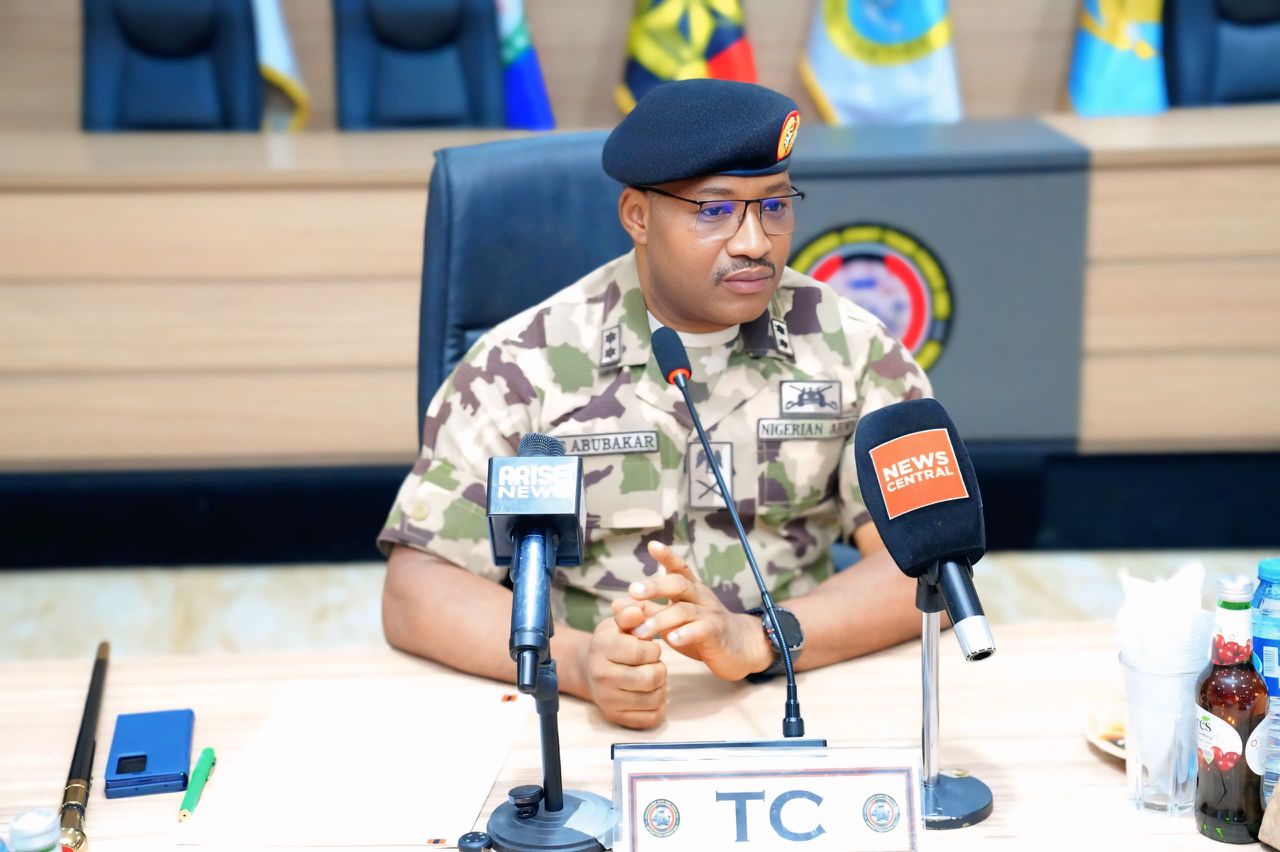
This is where the significance of Major General Abubakar’s command tour becomes more evident.
A commander cannot effectively lead a theatre of operations from an office alone. The realities of combat are often different from what appears in operational reports. Roads that look accessible on a map may be difficult to navigate. A seemingly quiet location may remain vulnerable to terrorist infiltration. And troops operating in isolated areas may face challenges that are not immediately visible from headquarters.
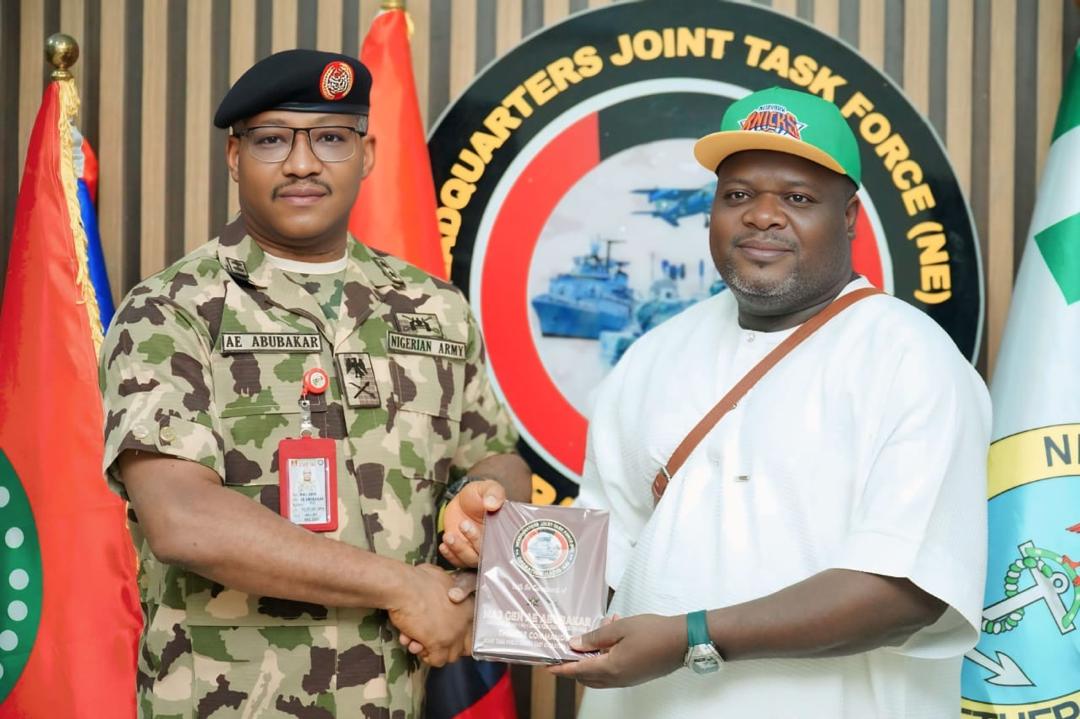
By physically moving through operational areas, the Theatre Commander was able to engage troops directly, inspect facilities and receive first-hand assessments from commanders and personnel operating at the frontlines.
The visit to the Maimalari Cemetery in Maiduguri also provided a sombre reminder of the price paid by soldiers in the campaign against terrorism. Behind every name engraved in military history is a family, a community and a generation of Nigerians who made the ultimate sacrifice in defence of the nation.
For troops still operating in the theatre, such reminders reinforce the significance of their mission. The war against terrorism is not merely about territory. It is about ensuring that the sacrifices of fallen comrades translate into lasting security for communities.
That objective remains particularly important in the North-East, where years of insurgency disrupted education, destroyed livelihoods, displaced families and weakened local economies. Every community returned to relative normalcy represents another step in the larger process of rebuilding.
The military’s gains therefore cannot be measured only by terrorists neutralised or weapons recovered. The restoration of confidence among residents, reopening of access routes, protection of farmlands and the return of displaced populations are equally important indicators of progress.
Major General Abubakar’s tour also underscored the importance of leadership at the tactical level. Soldiers deployed to remote locations need more than weapons and orders. They need confidence that their commanders understand their circumstances, recognise their sacrifices and remain committed to providing the support required for them to succeed.
The interaction between commanders and frontline troops is therefore an important component of operational effectiveness. It strengthens morale and enables senior commanders to understand challenges that may not be fully captured in formal briefings.
The Theatre Commander’s engagement with formations and troops also comes at a time when the counter-insurgency campaign is evolving. Terrorist groups are increasingly forced to rely on asymmetric tactics, exploiting difficult terrain, isolated communities and vulnerable routes. This requires the military to remain adaptive, intelligence-driven and constantly prepared for changing threats.
The gains recorded under Operation Hadin Kai should consequently not be interpreted as the end of the war. Rather, they represent progress in a campaign where the enemy’s ability to inflict damage is being progressively challenged.
The surrender of thousands of terrorists and their associates, the disruption of terrorist activities, the recovery of weapons and the sustained presence of troops across critical locations demonstrate that the military campaign has produced significant results. But the persistence of isolated attacks and terrorist cells means that complacency remains one of the greatest dangers.
For Major General Abubakar, rounding off the command tour therefore carries a dual message. It is a moment to acknowledge what has been achieved, while recognising the distance that remains to be covered.
The military’s responsibility is not simply to defeat terrorists on the battlefield but to create the security conditions necessary for communities to live, farm, trade, educate their children and rebuild their lives without fear.
Across the theatre, the scars of the insurgency remain visible. Cemeteries bear the names of fallen soldiers. Communities continue to recover from years of destruction. Thousands of displaced persons are still rebuilding their lives, while the military continues to manage the complicated consequences of mass surrender.
Yet, amid those challenges, another picture is emerging: one of a military operation steadily denying terrorists the dominance they once enjoyed in parts of the North-East.
Major General Abdulsalam Abubakar’s command tour has consequently ended with more than a review of military positions. It has provided a snapshot of a campaign in transition — from an era when terrorists could seize territory and terrorise communities with relative ease to one in which sustained military pressure is forcing many of them to surrender, flee or abandon their strongholds.
The road to lasting peace may still be long, but the gains recorded by Operation Hadin Kai demonstrate that the battle is moving in a direction that offers renewed hope.
For the troops who remain at the frontlines, however, the message is clear: the mission continues, the pressure must be sustained and the ultimate objective remains the restoration of enduring peace and security across the North-East.
About the Author