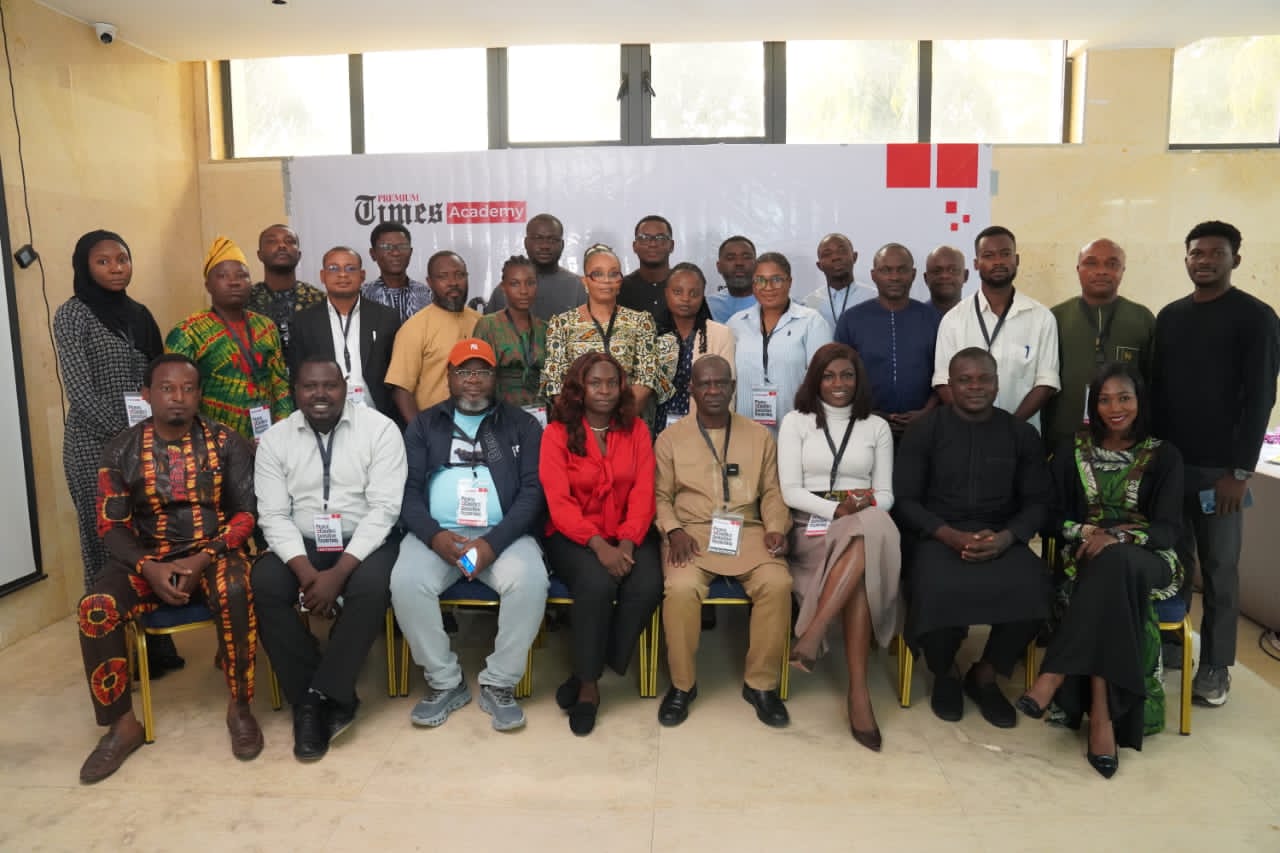
By Odita Sunday
Professor Isaac Albert of the University of Ibadan has urged Nigerian journalists to go beyond reporting the immediate events of conflicts and investigate their underlying causes, actors, consequences and possible solutions.
Albert, a professor of African History, Peace and Conflict Studies, gave the charge during a two-day training organised by Premium Times Academy for journalists on Peace and Conflict-Sensitive Reporting in Abuja.
He said journalists were working in an environment where their reports could either deepen existing divisions or contribute to a better understanding of the issues driving conflicts, stressing the need for practitioners to continually develop their conflict-analysis skills.
According to him, the international respect accorded Nigerian journalists is largely connected to the difficult circumstances under which they operate and the valuable information they provide about the country’s conflicts.
“One thing I’ve observed is that Nigerian journalists are highly respected, normally. Unfortunately, when we come back to the country, I don’t see that type of celebration of ourselves.
“And one of the reasons why we are highly celebrated is that you work under very, very difficult circumstances. And therefore, students of peace and conflict studies and students of communication studies, most of their case studies are from Nigeria,” he said.
The don challenged journalists to examine how their reporting could contribute to resolving rather than worsening the country’s security and conflict challenges.
“How do you report Nigeria without getting into trouble? How do you work in this environment in such a way that you don’t add to the problems of Nigeria?” he asked.
Albert said the training was not necessarily designed to replace the existing professional practices of journalists but to improve their ability to analyse conflicts and provide more meaningful reports.
He identified three key objectives of conflict-sensitive reporting as understanding the nature and dynamics of conflicts, identifying their causes and actors, and developing basic conflict-analysis skills.
According to him, the changing nature of conflicts, including the emergence of violent incidents in democratic societies, makes it necessary for journalists to continually reassess their understanding of conflict and its manifestations.
He said the causes of conflicts must be examined beyond their immediate manifestations, noting that journalists needed to understand the historical and social context of issues they report.
Albert said the Biafra agitation, farmer-herder conflicts and communal disputes were examples of issues that required deeper investigation into their origins and persistence.
“If you are looking at Biafra agitation, it didn’t start today. Why has the agitation continued? The so-called farmer-herder crisis is not a new phenomenon. So why has it continued? When there are communal crisis between two communities, most times great grandfathers of those communities they’ve been fighting, why has it remained now?” he asked.
He warned that journalists who reported conflicts without understanding their context risked producing only superficial accounts of the issues.
The professor said journalists must also understand the actors involved in conflicts and the consequences of their actions, stressing that reporting should not be limited to what is immediately visible.
He further urged journalists to return to communities after reporting incidents of violence to investigate how affected populations were attempting to resolve their disputes and rebuild relationships.
“Now, why are we here? We have this topic. We believe that government needs to report not only events. We are not reporting just only events. There are also meanings, causes, actors, and consequences,” Albert said.
He added that the manner in which conflicts were framed could influence public understanding and response, making conflict sensitivity an essential part of professional journalism.
“Conflict-sensitive reporting begins with a clear understanding of what conflict is and how it lives. And that is why we are starting this interaction with this topic, the nature of conflict,” he said.
Albert noted that journalists’ reports were valuable to scholars because reporters were often closer to unfolding events and maintained continuous engagement with the issues they covered.
He urged journalists to strengthen their analytical skills, saying their reports could be used by academics to develop intellectual conclusions about conflicts.
The professor also called for greater attention to people and organisations working to promote peace, saying journalists should investigate and report the efforts of peacemakers and community members involved in resolving conflicts.
He said the public needed to know not only who was affected by a crisis but also who was providing assistance and how communities were working towards recovery.
Similarly, the Editor-in-Chief of Premium Times, Musikilu Mojeed, said journalists covering humanitarian crises must prioritise saving lives, improving humanitarian effectiveness and exposing response inefficiency and corruption.
Mojeed, who spoke on “Sourcing Relevant Humanitarian Information Data”, said crisis reporting must be evidence-based, supported by reliable data and adequate context.
“So your role, we’ve been talking about this all day. Your role is to save life, isn’t it? So your role is to save life as much as possible. Our role as professional journalists is to improve humanitarian effectiveness, provide better psychosocial support to the people who are suffering, expose response inefficiency and corruption. These basically are your roles during humanitarian crisis,” he said.
He warned journalists against sensationalising crises, stressing that poorly verified or exaggerated reports could fuel tension and further endanger lives.
Mojeed also urged journalists to ensure that their reports gave affected persons a voice, helped manage community expectations and provided information about available assistance.
He said journalists must hold authorities accountable when humanitarian responses were inadequate, while also reporting the contributions of organisations providing assistance to affected communities.
The training also featured discussions on ethical standards in reporting hate speech and fake news, practical application of conflict-sensitive reporting principles, and the importance of accuracy and early-warning reporting.
Associate Professor of Communication and Media Studies, Joan Hassan, urged journalists to avoid bias and refrain from circulating fake news, stressing that media organisations had a responsibility to mitigate hate speech.
The Managing Editor of Premium Times, Idris Akinbajo, who led a session on applying conflict-sensitive principles to practical reporting scenarios, said journalists must report facts accurately and help readers understand the root causes of conflicts.
“Our job as journalists is to report facts. The fundamental principle of our job is accuracy,” Akinbajo said.
He urged journalists to pay attention to early warning signals of impending confrontations, stressing that a focus on violence alone could make the media miss opportunities to alert the public to emerging threats.
About the Author